If you spend any time in the world of charities, you will have heard the phrase ‘systems change’. It gets used a lot, often as shorthand for work that tries to shift the conditions that give rise to social problems.
We try to avoid it as much as possible, because the language of systems change doesn’t make sense to a lot of people. Most would struggle to define it. What is a system? Can you point to one? Who controls it? And how do you actually change it?
This matters. Systems are created by people, so to change the conditions that create problems like poverty, we need to convince people - politicians, civil servants, employers, the public - to think or act differently. We can’t expect them to support what they don’t understand.
There’s a lot written about systems change. If, like me, you find much of it academic and abstract, the best way to understand it is to look at the practical things that are being done.
So that’s what I want to do, using examples from the work we fund to help you picture what it means in practice.
Our approach to ‘systems change’
We start with big problems, all related to reducing poverty, and then work with people who have broken those problems down into smaller, more manageable parts.
Take London’s housing crisis, easily the biggest contributor to poverty in the city. Like all the systems I’ll talk about, housing is ultra complex. It involves central government, local authorities, the GLA, private businesses, and housing associations. It intersects with investment, planning rules, building regulations, politics, environmental protections, and immigration policy. The list goes on.
Want to reduce poverty by making housing more affordable? Where do we even start?
Breaking it down, thinking about where we can make the most difference, and who we can partner with, is how we make sense of it. This has led us to focus on those at the sharpest edge of the crisis: households in temporary accommodation (TA).
What is a system? Can you point to one? Who controls it? And how do you actually change it?
Even this is a huge problem to solve, so we’ve had to think pragmatically, but still ambitiously, about where things could improve. This has led us to work with others to try and improve the day-to-day conditions for people in TA, through a campaign to ensure access to basics like a place to wash their clothes, prepare a hot meal, and access to free WiFi.
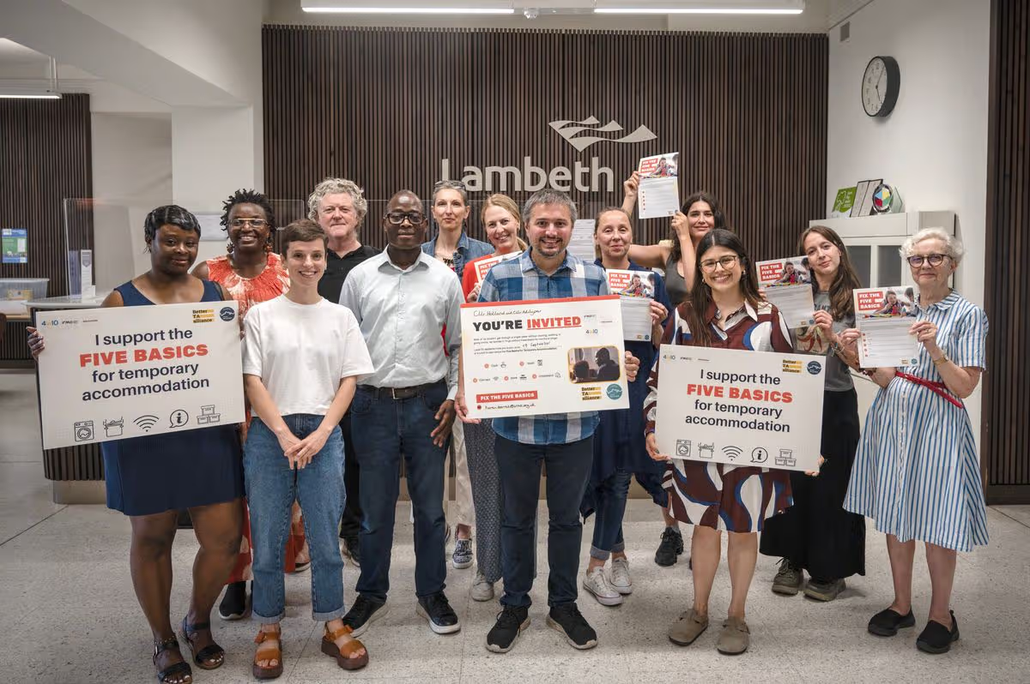
Campaigners from the Five Basics Campaign at Lambeth Council
The coalition that is campaigning for better quality TA is building experience and relationships, gaining confidence from each win. They have their sights on something much bigger – ending TA altogether – but it takes time, and progress on incremental wins, to build the power to deliver on such ambition. Over time, smaller changes can add up to something bigger.
I’m aware this kind of incrementalism has its critics. It can look like tinkering, lacking ambition while the world gets worse.
The alternative is to focus on big ideas and moments of transformation. Occasionally, there are windows where rapid change might be possible. But they are exceedingly rare, and over twenty years I’ve been in the sector, big shocks like the financial crisis, austerity, Brexit, Covid, and the cost of living crisis, haven’t catalysed the change we had hoped. Instead, they have just compounded the problems we face.
Perhaps the moment for large-scale change is coming, or is already here. But until that’s clear, we need both approaches. Big ideas depend on people and communities having the power to deliver them, and building that power often starts long before those moments arrive.
Making London’s economy fairer: systems change in practice
As an anti-poverty charity, it makes sense to focus on the economic system Londoners operate within. this system is shaped by everything from global markets and geopolitics, to decisions made by MPs about tax, or councillors sitting on planning committees. Beneath this are millions of people and businesses, each making micro decisions that add up to something much bigger. Making London’s economy fairer is a gargantuan task.
One area we’ve focused on is helping low-income Londoners get good jobs, with decent pay and conditions. Most notably, we’ve been strong supporters of the London Living Wage. The most recent campaign we funded led to £330m in additional wages for Londoners. This didn’t happen overnight, it’s the result of 20 years of organising and campaigning by Citizens UK and others.
We’re also supporting newer efforts. We’ve funded the Centre for Progressive Change to push for reforms to statutory sick pay, by organising workers, meeting MPs, and engaging with civil servants to influence the Employment Rights Bill.
The law might say workers are entitled to holiday pay or protection from unfair dismissal, but for many low-paid workers, those rights don’t exist in practice. We’ve funded organisations like Work Rights Centre, which supports people to resolve workplace issues, while using those cases to expose patterns of exploitation. Their CEO, Dr Dora-Olivia Vicol, has recently been appointed as an advisor to the Government’s new Fair Work Agency.
Big ideas depend on people and communities having the power to deliver them, and building that power often starts long before those moments arrive.
We’re also seeing how AI and algorithms are reshaping the labour market, often invisibly. For low-paid workers, decisions about hiring, shifts, and performance are increasingly automated. We recently funded Organise to develop an ‘early warning system’ for the use of AI in the workplace. The Institute for the Future of Work is learning from the experience of frontline organisations to push government and regulators to ensure these systems don’t quietly embed unfairness.
Alongside this, we’ve started work to influence the financial systems low-income Londoners rely on. Our focus is the poverty premium - the extra cost of things like energy, insurance, or banking.
We’ve funded organisations like ACORN, who are organising communities to campaign against the use of bailiffs for council tax debt. We’ve supported Policy in Practice to help water companies use data to identify people missing out on social tariffs. And we’re backing the Fair by Design campaign, which is pushing for national policy change to eliminate the poverty premium over time.

Some systems are easier to see than others
We also fund work on systems where government has more direct control, particularly welfare and immigration.
We’re proud to support Changing Realities, a group of low-income families who played a key role in influencing the government’s child poverty strategy, including writing a foreword for the published strategy. Their work shows how powerful lived experience can be in moving politicians to act, and the Prime Minster thanked the families at a reception in Downing Street before Christmas.
On immigration, we established and continue to fund the Strategic Legal Fund, managed by the Immigration Law Practitioners’ Association (ILPA). The Fund supports organisations to use the law to challenge immigration policy. We also fund ILPA to convene lawyers and advisers, helping coordinate efforts to push for reform.
Some systems are more intangible and contested. These are often described as ‘systems of oppression’ - ways in which society disadvantages people because of who they are. Our work focuses on justice for disabled people, and minority ethnic communities, though these categories overlap with others like age, gender, sexuality, religion, and class.
These systems don’t sit in one place. They show up across areas like employment, housing, public services, and everyday interactions. That makes them harder to pin down, but no less real, most starkly reflected in the high proportion of disabled people, or minority ethnic groups, living in poverty.
One approach we think is effective is building the power of communities to drive change themselves. Our Disability Justice Fund, co-funded by City Bridge Foundation, invests in organisations led by deaf and disabled people (DDPOs), so they can campaign directly. Many of the groups we fund came together to challenge proposed cuts to disability benefits in the government’s Pathways to Work green paper. By working collectively, and engaging MPs through a public affairs approach, they helped shift the government’s position.
This is steady, generational work
All the examples I've shared are really inspiring. They're driven by people dedicating their lives to creating change.
They're using the law to challenge unfairness, organising and amplifying lived experience, producing research that reshapes how problems are understood and using data to help institutions act differently.
None of these things, on their own ‘fix’ a system, and inevitably some will fail altogether. But over time, these approaches help change who has power, what decisions get made, and what feels possible.
It is this steady work, often generational, that ‘systems change’ is really about.