The new Fair Work Agency is a major opportunity to fix a labour market enforcement system that currently leaves too many workers unprotected.
But the Agency will only succeed if it is built on the right foundations. This briefing sets out three priorities to ensure the FWA works for all workers, including those most at risk of exploitation.
The briefing has been produced by a coalition of organisations working to improve conditions for the UK's most vulnerable workers.
What is the Fair Work Agency?
The Fair Work Agency, created in the Employment Rights Act 2025, is a new single enforcement body designed to tackle labour market abuses more effectively than the current system.
Launching in April 2026, the agency will bring together the functions of three existing enforcement bodies under one roof. But without the right foundations, the FWA risks repeating the failures of the fragmented, under-resourced system it replaces.
Key recommendations
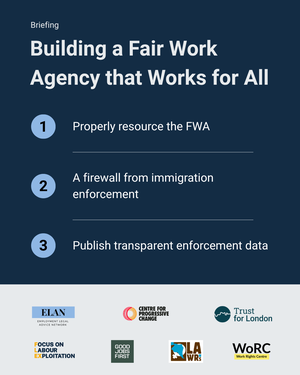
The briefing calls on the government to:
- Properly resource the FWA, with enough inspectors, proactive enforcement capacity and a regional presence.
The CIPD estimates that an additional £300 million per year is needed for the Agency to operate at a meaningful level. International best practice recommends one labour inspector per 10,000 workers and a 60/40 split between proactive and reactive inspections.
Current UK enforcement bodies fall far short of these benchmarks. - Ensure the FWA is a safe and trusted enforcement body for migrant workers. One in five UK workers was born abroad, rising to 45% in London.
For many, fear that coming forward could affect their immigration status stops them from reporting abuse. A firewall separating the FWA from Immigration Enforcement is essential.
Without it, exploitative employers can weaponise immigration status, suppressing reporting and enabling abuse to continue unchecked. - Publish transparent enforcement data, covering inspection activity, enforcement actions, sector-specific patterns and the balance between proactive and reactive work.
Transparent data will help policymakers, civil society and the public identify where enforcement is falling short and hold the Agency to account.
If you work for an organisation that would like to support these asks, please reach out to Emma Wilkinson, director of ELAN.
Supporting organisations
This briefing was put together by a coalition, made up of:
- Employment Legal Advice Network (ELAN)
- Trust for London
- Centre for Progressive Change
- Focus on Labour Exploitation (FLEX)
- Latin American Women’s Rights Service (LAWRS)
- Work Rights Centre (WoRC)
- Good Jobs First
The following organisations have signed up to support the briefing and its asks so far:
- AdviceNow
- City Community Legal Advice Centre
- Fashion Roundtable
- Free Representation Unit (FRU)
- Greater Manchester Law Centre
- Institute for the Future of Work
- Kalayaan
- Labour Behind the Label
- Maternity Action
- Protect
- Refugee Workers Cultural Association
- South West London Law Centre
- Southwark Law Centre
- Working Families
Download the full briefing
26 March 2026