Disabled people are often invisible in the homelessness system. For Verity, an autistic woman from Lambeth, three years of temporary accommodation became a cycle of confusion, exhaustion and neglect.
Her story reveals how poor communication and lack of understanding can trap Disabled people in homelessness, and what needs to change.
Stuck in a broken system
Between 2021 and 2024, I experienced three years of homelessness.
For the first two years, I lived in a hotel. I had almost no communication from the council during that time. Near the end of my stay, a charity commissioned by the council to tackle their backlog knocked on my hotel door. This was the first contact I’d had in months.
Then the hotel evicted me because the council hadn’t kept in touch with them. I couldn’t reach anyone on the phone and suddenly had nowhere to go. The hotel told me I could sleep in the lobby — I didn’t. I sofa surfed until the next day, when the council placed me in another hotel.
In total, I spent nearly two and a half years living in hotels, before the charity working with me persuaded the council to put me in a temporary flat.
Throughout all this time, no one ever discussed my needs as a Disabled person.
Invisible needs, ignored
Too often, temporary accommodation doesn’t take into account people’s needs – whether that’s families without a kitchen, people living with HIV in placements with no privacy [link to research] or people with invisible disabilities, like Verity, not having their needs taken into account.
I didn’t know how to use the council’s bidding system to find a permanent home that was suitable for me as a disabled person. My sister tried to help, but both of us were passed from one department to another. We never found anyone who could explain how the system worked.
During my time in temporary accommodation, I didn’t have access to even the most basic necessities. I’m gluten- and dairy-free, but in hotel rooms without a cooker, I couldn’t prepare food properly.
In one hotel, I would have had to pay extra just to get online. Later, in a temporary flat, I had an unreliable internet connection that I could only afford through my credit card.
Just managing the accommodation was exhausting. The council wanted me to phone and leave messages — messages no one ever answered. Without a response, I couldn’t renew my booking at the second hotel unless I went in person to the civic centre and waited for hours. I had to do this every couple of weeks.
At the civic centre, staff refused to communicate with me in ways that worked for me as an autistic person. The hotel receptionist showed me more compassion — she even let me leave my case in the lobby while I queued at the civic centre.
Moved out of borough, and out of reach
Many thousands of people in temporary accommodation are moved far from to different boroughs, far from their support networks and services. Verity’s story shows the impact this can have.
Eventually, the charity supporting me persuaded the council to move me into a temporary flat. But it was out of borough — the council had run out of local placements. I was moved because I couldn’t cope with the stress of constantly rebooking hotel rooms.
No one at the council discussed how being moved out of borough would affect me as a Disabled person. Suddenly, I’d lost my local GP, my place on the waiting list for mental health support, my informal network and the area I knew.
In that year alone, I had five different GPs. When I was finally rehoused back in my borough — where I’d lived since 1997 — I was no longer eligible for my old GP’s catchment area. I had to start again.
I lived out of borough for too short a time to access mental health support where I was living, the waiting list was lengthy — but just living out of borough at all meant I had to rejoin waiting lists when I moved back.
The whole experience happened because I had no one to talk to at the council. So much public money was wasted keeping me homeless. Being homeless and voiceless for so long had a huge impact on my already fragile mental health.
A dehumanising process
Homelessness can strip people of control and dignity. Like many thousands of people in temporary accommodation, Verity felt ignored, and uncertain of even the most basic information about her situation.
One day, I was forced to move accommodation while I had a chest infection and a stomach bug — even though my doctor had certified me unfit to move. Nobody listened. It was degrading.
I lived in constant fear of doing something wrong on the bidding system and being left with nothing. You only get so many chances so I didn’t want to make a mistake.
I wrote to the councillor responsible for Disabled people. I didn’t get a reply. Months later, she explained she’d been seriously ill, but by then, nothing had changed. The system is still broken for Disabled people.
I also wrote to the DWP about my experience of homelessness. They never responded.
Because no one answered, I felt voiceless. I still don’t feel the council has learned anything from my case, or begun to treat Disabled homeless people differently.
Homelessness was an unnecessary, damaging and expensive experience — both for me and for the system.
If I could change one thing, it would be better communication. I needed a named contact — someone who understood that clear, consistent communication is an access need for me as an autistic person. Something so simple could have made all the difference.
Finding a voice
After years of feeling unheard, Verity is now rebuilding her life. With support from DASL, she’s finding her voice — and calling for lasting change in how councils treat Disabled people.
Now, after a year in my new housing association flat back in Lambeth, I’m still rebuilding. I’m a middle-aged woman with a communication disability, trying to find my place in a new neighbourhood.
DASL (Disability Advice Service Lambeth) has given me a platform to tell my story — no one else listened. The council never responded to my letter explaining how disastrous homelessness had been for me. Local mental health services still aren’t sure how to support me as an autistic person with mental health issues.
In the end, it wasn’t the council who rehoused me — it was a housing association. If it had been left to the council, I might still be homeless.
I want the council to be held accountable. I want other homeless Disabled people to know they are not the problem — that others have been through the same thing. And I want the council to finally improve how it communicates with Disabled people.
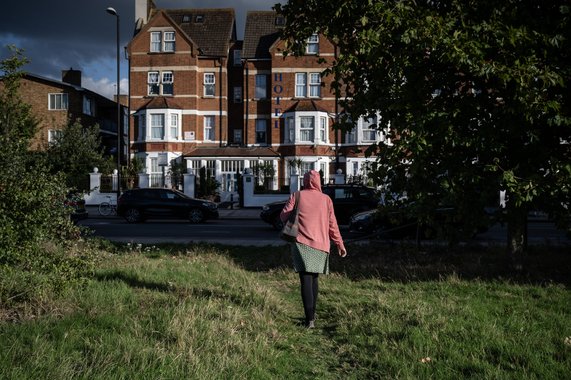
As part of sharing her story, Verity wrote captions for a photo gallery to shed light on her experience. See these below.
What needs to change?
We’re immensely grateful to Verity for sharing her story with us. London’s temporary accommodation crisis is at record levels – and stories like Verity’s show the devastating human impact this is having.
In the long run, we want to see temporary accommodation end. This will take time, and requires a huge investment in social homes.
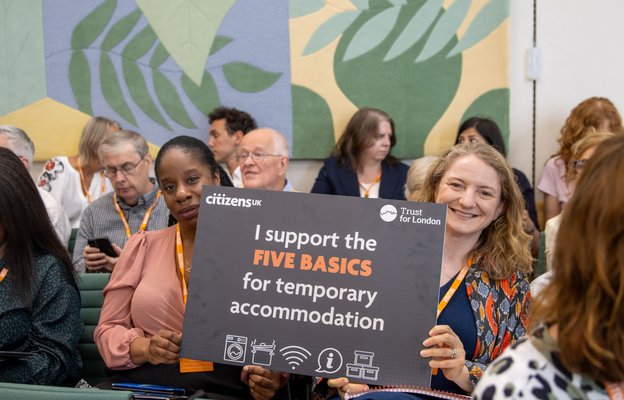
In the meantime, we want all London councils to commit to ensuring that all residents in temporary accommodation have access to the ‘five basics’. These are five necessities that many of us couldn’t go without but that many, like Verity, are forced to:
- COOKING FACILITIES: a place to prepare a hot meal
- LAUNDRY ACCESS: a way to wash clothes that is affordable and easy-access
- WIFI: reliable, free internet connection WiFi
- SECURE STORAGE: somewhere to safely store personal belongings
- CLEAR INFORMATION: updates on rights, repairs and move‑on plans.