In this analysis, we explore rising levels of youth unemployment in London. We ask if there are early signs that AI is changing the labour market, and hear from young Londoners themselves about what challenges they face and what needs to change.
Key findings at a glance:
- Youth unemployment in London has risen sharply since 2023, even as unemployment for older adults has stayed relatively flat.
- Some boroughs are seeing extreme spikes, with young people in parts of East and West London hit hardest.
- At the same time, the jobs young people rely on have collapsed - with huge drops in vacancies across retail, admin, customer service and entry-level office work.
- This mirrors early warning signs from employers and labour market data that AI and wider economic pressures may already be reshaping entry-level work.
- Together, these trends raise urgent questions about why young Londoners are being disproportionately locked out of work - and what can be done to stop inequality widening further.
Youth unemployment has gone up sharply in the last few years, while unemployment among older people has stayed around the same.
And in London, the youth unemployment rate is especially high. In this piece, we explore what the data tells us to help us understand what’s going on – and ask whether there are early signs that AI is contributing to this.
First, a bit of context
In the wake of the COVID-19 pandemic, unemployment went up. London bore the brunt of this – at its peak in 2021, 6.5% of working-age Londoners were unemployed, compared to 4.8% in the rest of the country.
And then, as the country began to reopen, this seemed to correct itself. People found jobs, and the unemployment rate went back to below pre-pandemic levels.
Since 2023, though, another concerning trend has arisen – and one that’s less easy to explain. While unemployment has remained around the same level in the rest of England, it’s gone up sharply in London.
Youth unemployment usually mirrors wider trends – but not this time
Unemployment rates by age group (2004 Q4 - 2025 Q2)
Young people (16-24) have always been significantly more likely to be unemployed than those 25+. And young Londoners have always been more likely to be unemployed than those in the rest of the country.
But if we look over the last 20 years, the youth unemployment rate – both in London and the rest of the country – has followed broadly the same pattern as for those aged 25-64.
Basically, what happens to unemployment levels as a whole, happens to young people to an exaggerated degree.
In times of economic crisis, young people do tend to face employment shocks more sharply – see 2008 (financial crash) and 2020 (the start of the pandemic) in the chart above.
The last few years buck this trend. Young Londoners and young people across the country have seen a rise in unemployment we simply don’t see in adults aged 25-64.
And according to the Department of Work and Pensions, the number of young people claiming Universal Credit (UC) Health and Employment Support Allowance has risen by more than 50% over the past five years.
So concerning is the issue that the government has launched an independent review specifically looking at the rising number of young people not working or studying (Neets), led by former Labour Health Secretary Alan Milburn.
Where youth unemployment is rising fastest
Change in claimant count for 18-24 year olds 2025 (Q3) indexed to 2022 (Q3) (2023 to 2025 (Q3))
We know that youth unemployment is higher in London than the rest of England. But there are huge differences across the city.
This map shows how benefit claimant counts have changed in each borough – looking only at those with a requirement to seek work, rather than those signed off Disabled or sick. It gives us an insight into how unemployment levels have changed at a borough level in the last three years.
It shows a big discrepancy. Inner boroughs – especially those to the West of the centre – have seen a much smaller increase in youth unemployment by these measures.
By contrast those in East London and the far west have seen massive increases. For example, the number of young people on unemployment benefits increased by 40% in Ealing – and 0% in Camden.
A shrinking jobs market...
To understand what might be happening, we dug into the data about job vacancies advertised online. At a top level, there are simply fewer jobs available than there were three years ago – and this is especially the case in London.
The ONS has various ways of splitting jobs up, and one of those is using what are called ‘industry classifications’. This splits jobs into the type of role they are – for example ‘Skilled trade’ is one classification, ‘Admin and secretarial occupations’ is another.
Across all nine industry classifications, London has seen a significant drop in the number of vacancies advertised online between 2022 and 2025. So has the rest of the UK – but in London, it’s more extreme across every classification.
Vacancies data across London
Managers, Directors And Senior Officials (2017 Q3 to 2025 Q3)
Includes jobs such as corporate managers, directors, business owners, senior police and military officers, and functional managers across sectors like finance, marketing, and operations.
Professional Occupations (2017 Q3 to 2025 Q3)
Includes jobs like scientists, engineers, doctors, nurses, teachers, accountants, solicitors, architects, social workers, and other roles requiring degree-level qualifications.
Associate Professional Occupations (2017 Q3 to 2025 Q3)
Includes IT technicians, paramedics, nurses, laboratory technicians, graphic designers, journalists, estate agents, and roles supporting professional work.
Administrative And Secretarial Occupations (2017 Q3 to 2025 Q3)
Includes office administrators, receptionists, personal assistants, secretaries, data entry clerks, and customer service roles in offices.
Skilled Trades Occupations (2017 Q3 to 2025 Q3)
Includes electricians, plumbers, carpenters, chefs, bricklayers, mechanics, welders, butchers, and other craft and skilled manual workers.
Caring, Leisure And Other Service Occupations (2017 Q3 to 2025 Q3)
Includes care workers, childminders, teaching assistants, hairdressers, travel agents, fitness instructors, and hospitality workers.
Sales And Customer Service Occupations (2017 Q3 to 2025 Q3)
Includes retail assistants, checkout operators, sales representatives, call centre workers, market traders, and customer service advisors.
Process, Plant And Machine Operatives (2017 Q3 to 2025 Q3)
Includes factory workers, machine operators, drivers (lorry, bus, taxi), train drivers, and workers operating industrial equipment.
Elementary Occupations (2017 Q3 to 2025 Q3)
Includes cleaners, kitchen assistants, warehouse workers, labourers, security guards, postal workers, and other routine, unskilled roles requiring minimal training.
...especially for young Londoners
From data like that collected by the ONS, we know the type of jobs that young Londoners and young people are more likely to work in. In almost every case, these jobs have seen the biggest drop in vacancies.
For example, young Londoners are most likely to work in a category called 'Sales and customer service occupations’ - jobs like retail assistants, or customer service workers. In this category, there are fewer than half the number of vacancies that there were 3 years ago in London.
We can also delve into more specific occupations. Many roles that have historically been entry-level roles for younger people have seen huge drops in vacancies – admin roles are down 56%, sales roles are down 44%, customer service roles are down 59%.
Taken together, there are now far fewer jobs than three years ago — especially in the sectors young Londoners rely on.
This drop in vacancies has happened in the same time scale as the increase in youth unemployment.
Hear more from young Londoners.
Could AI be part of the problem?
Over the last couple of years, there has been increasing concern about the impact that AI will have on the job market. There’s a lot of hyperbole and worst-case scenario headlines – like claims that AI could replace half of all jobs in just a few years.
Combine this with the rising youth unemployment, it’s tempting to wonder whether this could be early signs of AI impacting the job market.
This is all happening in live time, and the data can take a while to catch up. But there are a few things we can say.
For example, research from the job search site Adzuna found that since the launch of ChatGPT in 2022, the number of new entry-level UK jobs has dropped by almost a third. However, this could also be due to other factors such as economic trends.
Economists at Stanford University in the US also believe that AI may have contributed a meaningful amount to the overall slowdown in hiring for entry-level workers. But they also state that the overall impact on hiring is likely currently small and there’s a lot that we don’t know.
Our analysis of vacancies data backs this up
Looking back at those 9 industry classifications, the biggest drops in vacancies have been in three categories:
- Professional occupations – for example white collar office jobs
- Sales and customer service occupations
- Admin and secretarial occupations
These are also three areas where AI is most likely to be able to do the job. The drop has been much smaller in categories like Skilled trade occupations, Caring leisure and other services, and Process, plant and machine operatives.
These jobs are more ‘hands-on’. They’re less easily completed by AI, and young Londoners are also less likely to work them.
A similar trend emerges when we look at more specific job categories. As well as the previously mentioned jobs, there has been a huge drop in ‘Web and multimedia’ roles, another popular career for younger people, and another role at risk from AI – down 44%.
Most jobs have seen a significant drop in vacancies since 2022. But all those that haven’t are in-person, hands on roles: Teaching and childcare associates; Building finishing trades; Hairdressers; B&B and Guest House Owners.
Of course, this is all very anecdotal. And it’s impossible to separate the impact of AI from other factors.
But it is also backed up by surveys. A British Standards Institution study across seven countries found that 41% of bosses said AI was allowing them to cut the number of employees.
Other factors making things harder for young Londoners
The period we've looked at, 2022-2025, doesn't just span the rise of AI in our everyday lives. It also covers a time of deep economic turmoil, a new government, a rising mental health crisis, and other factors.
Wider-economic turmoil
Rising costs and challenging macroeconomic conditions have meant that many employers are facing difficult decisions about their workforce. High inflation, rising energy costs, and increased borrowing costs have squeezed business margins, forcing many to reduce headcount.
When this happens, it's often entry-level positions that are cut first. Employers may choose to leave vacant positions unfilled or consolidate roles, reducing opportunities for new entrants to the job market. And with the rise of AI, employers may be even more likely to take these decisions. Young and less-experienced workers bear the brunt. In London specifically, where costs are higher, these economic pressures are particularly acute.
Low pay and insecure work
Entry-level jobs are often low-paid and struggle to meet the city's high cost of living, which is a major barrier to work. For young people, the benefits of taking a job on minimum wage (which is lower for 18-20 year olds) can be almost entirely outweighed by the travel costs of getting there.
Research by the Princes Trust found that 1 in 10 young people had to turn down a job because they simply couldn't afford to take it.
The quality of jobs available is also a concern. Too often, the roles on offer to young people are zero-hour contracts or gig work with low stability and few progression opportunities. This insecurity makes it harder for young people to plan their futures or gain the experience and training needed to move into better roles.
In their own words - young Londoners on the job market.
Skills and experience gaps
Many young people find themselves in a catch-22, where most jobs ask for a certain amount of experience, even when described as entry-level roles. This can stop young people from applying for those roles.
In the same vein, many young people feel inadequately prepared for the work place. Research from Youth Futures Foundation found that for young people, a lack of skills or training is the biggest obstacle to entering the workforce.
A mental health crisis
There is a major mental health crisis among young people, which both contributes to and is exacerbated by youth unemployment. Research by the Youth Futures Foundation shows that mental health is a key barrier to employment: a third of young people reported having a mental health condition, and of those, 85 % believed their condition affected their ability to find work or perform in a job.
The uncertainty of job-searching, financial strain and repeated rejection can all take a heavy toll on wellbeing — making the already steep climb into employment even harder.
Government minimum wage policy
This analysis has also coincided with changes to government wage policy. Between 2023 and 2025, the minimum wage for 18-20 year olds has increased by over 30% – from £7.49 to £10.00 per hour. These are some of the largest increases ever seen for this age group, designed to close the gap with adult wages, with the eventual aim of 18-20 year olds having the same minimum wage as older adults.
This is the right ambition. But changing policies like this too quickly can have inadvertent effects on younger workers. Young people end up caught in the crossfire between calls for decent pay and concerns about business bottom lines, and steep rises in the minimum wage could unintentionally make employers more hesitant to hire at entry level.
Economists at Resolution Foundation, for example, are now urging the government to think carefully about making minimum wage equal for all age groups because they argue this would risk making it even harder for young people to get a foot into the labour market. This creates a difficult balance between ensuring young people can afford to work and maintaining employment opportunities.
What does all this mean?
Ebbs and flows in unemployment levels are to be expected, and there are many factors at play in rising unemployment among young people. The role of AI, though, is new, and threatens to make things worse.
We need to ensure that as technology changes our society, it does so in a way that improves our lives, rather than simply reducing our job prospects.
Without action, too many young Londoners will be locked out of good work — and inequality in the capital will deepen even further.
What needs to change
Young Londoners themselves have clear ideas about what would help. We put five possible solutions to the young people we spoke to – with high-quality apprenticeships and higher pay for entry level jobs coming out as clear priorities.
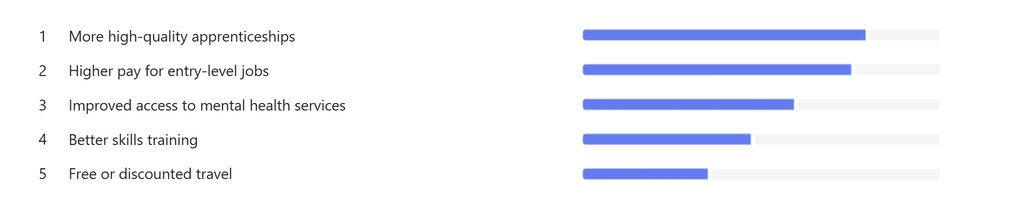
Progress is already being made on some of these issues. The November 2025 Budget confirmed that SMEs will no longer pay for apprenticeship training for under-25s, removing a key barrier for small employers.
The Budget also confirmed £820m for the Youth Guarantee and reforms the Apprenticeship Levy into a new Growth and Skills Levy from April 2026, allowing levy funds to be used more flexibly – including for shorter training courses.
The government also increased the minimum wage for 18-20 year olds significantly - a big pay boost which will help many young people into work. It is still, however, not sufficient to meet London's living costs - only the real Living Wage reflects the cost of living. And at the same time, some economists warn this could potentially reduce job opportunities for this group.
On top of these solutions suggested by the young people we spoke to, there is also lots of evidence about what policy solutions will work. For example, some of the key solutions proposed include:
Expand the Youth Guarantee
The Youth Guarantee could also be a game changer – a £820m commitment to ensure that every eligible 18–21 year old who has been on Universal Credit and looking for work for 18 months is guaranteed a six-month paid work placement, alongside access to apprenticeships, training and personalised job support.
Eight Youth Guarantee trailblazers are now operating across England, including two in London.
These pilots are matching young people to job and training opportunities and will inform the national roll-out. One London pilot focuses specifically on supporting care leavers in central London to progress toward employment, education and training.
Research from Youth Futures Foundation shows the most effective programmes combine vocational training, mentoring, and real work experience. But these need to reach young people where they are.
And many experts like Youth Employment UK are calling on the government to expand the Youth Guarantee to those up to 24 years old, with earlier intervention before young people have been unemployed for 18 months.
Read Youth Employment UK's budget response here.
Address the AI challenge head-on
Rather than letting AI simply displace young workers from entry-level roles, we need proactive policies to ensure young people can benefit from technological change. This means investing in skills training that prepares young people for the jobs of tomorrow, not just yesterday.
Without action, too many young Londoners will be locked out of good work – and inequality in the capital will deepen even further. The evidence is clear: we know what works to support young people into employment. Now we need the political will and investment to make it happen at scale.
Young people need meaningful jobs, adequate pay to live on, proper training and mentoring, and support for their mental health. Most fundamentally, they need a society that values their potential and invests in their futures – not one that sees them as expendable in the face of economic pressures and technological change.