Living Wage Campaign
In a noisy world, we all need to seek out good news. As 2025 comes to an end, we wanted to share some of the things making us feel hopeful as we reflect back on the year.
We know this has been another challenging year. Charities and community organisations continue to face funding pressures, increasing demand and an uncertain policy landscape.
We're deeply grateful to all our partners and grantees who have persevered through these difficulties, and to the communities who continue to organise and support one another despite the obstacles they face.
Across our city, ordinary people are doing extraordinary things to make London a fairer city. From tackling issues like child poverty and low wages, through to building powerful racial and disability justice movements. We hope you find these successes as inspirational as we do.
These are just five examples from a year in which our partners worked tirelessly to improve the lives of Londoners. Even in the most difficult of circumstances, real change is happening that is improving people’s living standards.
Thank you all for your tireless work this year. Together, you're proving that change is possible – even when it feels impossible. Let's keep building in 2025.
In November 2025, chancellor Rachel Reeves announced that the two-child limit will be scrapped. In an increasingly difficult context for everyone fighting for social and economic justice, this is huge cause for optimism.
The policy, introduced in 2017, has pushed hundreds of thousands of children into poverty. Although there is much more to do to truly tackle child poverty, this represents a major victory for campaigners across the country – from big national charities to grassroots organisations, including many of our partners.
Relentless campaigning by organisations like 4in10, Z2K and Changing Realities made this victory possible. Changing Realities’ role has been acknowledged by the Prime Minister himself – they were even the subject of Prime Minister Keir Starmer’s first Substack.
Most importantly this decision will help lift around thousands of children in London out of poverty.
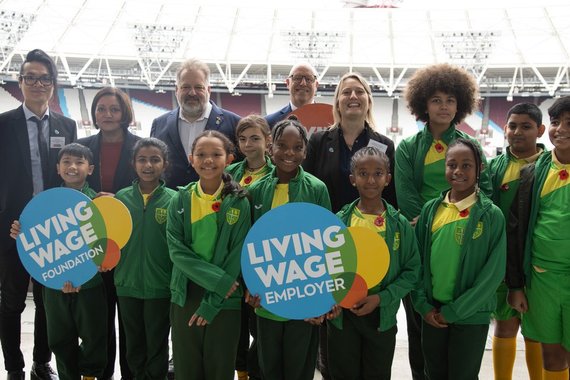
It's been four years since we invested £4m in the campaign to Make London a Living Wage City. The achievements since then have been extraordinary, and life-changing for tens of thousands of workers.
The project has doubled the number of London-based Living Wage Employers, with 2,500 new employer accreditations. This means more than 70,000 Londoners have seen their wages go up over the course of the project – putting £400m back into the pockets of workers from London-headquartered employers. This is set to reach £1.5bn by 2030.
Overall, the project has added £628 million total economic value to London's economy – showing that what's right for people can also be right for the economy.
Social tariffs are discounted rates for essential services like energy, water and broadband for low-income households. Getting these discounts to the people who need them most has been a persistent challenge.
Our funding to Policy in Practice supported a pioneering pilot on auto-enrolment for water social tariffs, in partnership with Thames Water and two London boroughs. By matching water debt data with council benefits records, they identified 1,234 eligible households not currently receiving support and automatically enrolled them, saving an average of £316 per year — over £390,000 in total annual savings.
For families choosing between heating and eating, an extra £316 a year is transformative. And this pilot proves auto-enrolment works – it can be scaled across London and beyond.
It feels like a difficult moment for the progressive movement. But things are happening that are worth celebrating.
Across our racial and disability justice funds, we're witnessing two collaborative, powerful movements flourish.
Racial justice: building momentum for ethnicity pay gap reporting
The partnership between ShareAction, Action for Race Equality, and Dianne Greyson shows the power of coalition-building. By combining policy expertise, community engagement and campaign leadership, they've coordinated parliamentary briefings, mobilised investors and kept pressure on government in a way none could have achieved alone.
The government is now planning to implement mandatory ethnicity pay gap reporting – a potential step change.
Disability justice: preventing harmful PIP cuts
Our disability justice fund has seen growing strength and collaboration. When the government proposed cuts to PIP earlier this year, funded partners mobilised immediately - coordinating campaigns and amplifying disabled people's voices as part of a broader movement that forced the government to back down.
Stopping harmful cuts is a victory in itself – it shows that when disabled people and their allies organize, they have real power. That unity is building something lasting.
Thousands of families across London are living in temporary accommodation without the most basic amenities. Earlier this year, we worked with our partners across the Better TA Alliance to launch 'Fix the Five Basics' – calling for everyone in TA to have somewhere to cook, wash clothes, store belongings safely, plus WiFi and clear information about their situation.
The momentum has been remarkable – from Greenwich to Westminster, councils are listening. Greenwich Council co-produced a new guide for residents with Creating Ground CIC, while Z2K's campaigning in Westminster secured pledges for named staff contacts and launderette vouchers.
On a national level, the government announced £84 million to tackle homelessness this winter in October – including £11m for children in TA. And in the Child Poverty Strategy, the government committed to ensuring no child has to live without a kitchen, a testament to the campaigning work of the Magpie Mums.
The campaign isn't over – there's still much more to do as we head towards next May's elections.